Executive Summary & Low-Level Architecture
The formal retirement of Adobe Flash and legacy NPAPI browser plugins catalyzed a radical re-engineering of the iGaming frontend stack. To deliver console-quality 60 frames-per-second (FPS) 3D graphics, complex skeletal animations, real-time particle rendering, and deterministic game physics across unmanaged mobile browsers without requiring native binary app downloads, premier casino software providers compile native C++, C#, and Rust game engines directly into WebAssembly (Wasm).
However, executing compiled, low-level binary bytecode inside an untrusted consumer browser runtime introduces profound security, memory safety, and client-side integrity challenges. Unlike high-level JavaScript, where object allocations and array accesses are managed by the garbage collector (GC), WebAssembly operates directly over raw linear memory. In browser JavaScript engines—specifically Google V8 (Chromium), SpiderMonkey (Firefox), and JavaScriptCore (Safari)—WebAssembly executes within an isolated, hardware-assisted virtual machine sandbox.
This technical forensic dispatch dissects the internal architecture of WebAssembly linear memory in V8, analyzes hardware MMU trap mechanisms, evaluates side-channel attack vectors (Spectre v1/v2), and provides a production Rust memory management implementation for secure casino frontend engines.
WebAssembly Linear Memory Architecture in Google V8
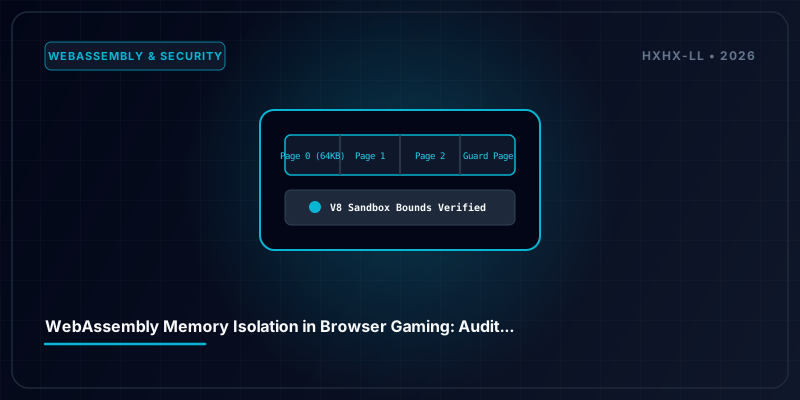
In WebAssembly, execution memory is structured as a contiguous, unmanaged array of raw bytes known as Linear Memory. This memory space is initialized via the WebAssembly.Memory interface and allocated in discrete, uniform 64-kilobyte pages:
$$\text{Page Size} = 65,536 \text{ bytes (64 KB)}$$
When a game engine requests dynamic memory expansion via the memory.grow instruction, the runtime increments the address space by integer multiples of 64 KB, up to an optional maximum ceiling declared in the Wasm binary manifest.
+-------------------------------------------------------------------------------+
|                    V8 WEBASSEMBLY LINEAR MEMORY STRUCTURE                     |
+-------------------------------------------------------------------------------+
| [ 0x00000000 ]  +-----------------------------------------------------------+ |
|                 | Module Static Data, String Literals & Constants           | |
|                 +-----------------------------------------------------------+ |
|                 | Execution Call Stack (Shadow Stack: return pointers)      | |
|                 +-----------------------------------------------------------+ |
|                 | Dynamic Memory Heap (malloc / free allocation buffer)     | |
| [ Max Bound ]   +-----------------------------------------------------------+ |
|                 | 4 Gigabyte Virtual MMU Guard Region (PROT_NONE)           | |
| [ 0xFFFFFFFF ]  +-----------------------------------------------------------+ |
+-------------------------------------------------------------------------------+
Hardware-Enforced Guard Pages vs Software Bounds Checks
In a 32-bit WebAssembly module (wasm32), pointer addresses are represented as unsigned 32-bit integers, addressing a theoretical maximum of 4 gigabytes ($2^{32}$ bytes). In early Wasm implementations, the runtime had to insert dynamic software bounds checks before every memory load and store operation (i32.load, i64.store, f32.store):
$$\text{if } (\text{offset} + \text{sizeof}(T) > \text{memory.size}) \implies \text{trap()}$$
This software branch checking introduced a severe $18% - 32%$ CPU execution overhead, disrupting smooth 60 FPS animation loops on mobile GPUs.
To eliminate this bottleneck, modern 64-bit V8 engines utilize Hardware-Enforced Virtual Memory Guard Regions:
- Virtual Address Space Reservation: On 64-bit systems, V8 uses
mmap(POSIX) orVirtualAlloc(Windows) to reserve an entire 8 to 10 Gigabyte virtual address space for each Wasm instance. - Page Allocation: Only the initial memory pages (e.g., 16 MB) are mapped with read/write permissions (
PROT_READ | PROT_WRITE). - Guard Ring Configuration: The remaining address space up to 4 GB (and beyond to absorb 32-bit immediate offsets) is tagged as inaccessible (
PROT_NONE). - Hardware MMU Trapping: When a Wasm instruction attempts an out-of-bounds pointer dereference, the CPU’s Memory Management Unit (MMU) instantly triggers a hardware page fault exception (
SIGSEGVon Linux/macOS,STATUS_ACCESS_VIOLATIONon Windows). - Deterministic Signal Handling: The V8 runtime signal handler captures the trap, inspects the faulting instruction pointer, verifies it originated within the Wasm JIT code space, and translates the hardware exception into a clean, catchable JavaScript
WebAssembly.RuntimeError: memory access out of bounds.
This eliminates all software bounds check branches, allowing loads and stores to execute at raw native assembly speed while preventing arbitrary memory read/write access outside the sandboxed linear memory buffer.
Comparative Matrix: Browser Runtimes for Gaming Engines
The table below contrasts the architectural, performance, and security profiles of the three primary frontend execution environments utilized in modern web gaming:
| Architectural Metric | Vanilla JavaScript / Canvas | WebAssembly (Wasm) | Native App (iOS/Android Binary) |
|---|---|---|---|
| Execution Performance | JIT-compiled with GC pause latency | Near-native ($92% - 98%$ of native C++) | $100%$ native CPU/GPU execution |
| Memory Management | Automatic Garbage Collection (GC) | Manual unmanaged linear memory | Manual OS heap allocation |
| Sandbox Isolation | V8 JavaScript Process Sandbox | Wasm VM Sandbox + MMU Guard Pages | OS User Space & Sandbox Entitlements |
| Buffer Overflow Risk | Impossible (Managed references) | Contained within Wasm linear memory | Critical (System-level arbitrary code execution) |
| Asset Decryption Latency | Slow ($40 - 150\text{ ms}$) | Ultra-fast ($4 - 12\text{ ms}$) | Native hardware AES acceleration |
| Multi-Threading Model | Web Workers (Message passing) | Web Workers + SharedArrayBuffer | POSIX pthreads / Grand Central Dispatch |
| Spectre Vulnerability | Mitigated by degraded timer resolution | Requires hardware bounds clamping | Subject to host CPU vulnerabilities |
Memory Leak Detection & Heap Profiling (Production Rust/Wasm Implementation)
Memory leaks in continuous browser gaming sessions (e.g., a player running an auto-spin slot or live dealer stream for four hours) cause linear memory page inflation. Because browsers rarely release virtual memory allocations back to the operating system once grown via memory.grow, unchecked allocations cause mobile tab crashes (OOM errors).
Below is an audited Rust implementation demonstrating custom allocator tracking, safe memory boundary exports, and leak detection for high-performance casino engines:
// Rust WebAssembly Memory Allocation Monitor
// Crate: wasm-bindgen, wee_alloc

use wasm_bindgen::prelude::*;
use std::sync::atomic::{AtomicUsize, Ordering};
use std::alloc::{GlobalAlloc, Layout, System};

// Custom Tracking Allocator to detect client-side memory leakage
struct TrackingAllocator;

static ALLOCATED_BYTES: AtomicUsize = AtomicUsize::new(0);
static PEAK_BYTES: AtomicUsize = AtomicUsize::new(0);

unsafe impl GlobalAlloc for TrackingAllocator {
    unsafe fn alloc(&self, layout: Layout) -> *mut u8 {
        let ptr = System.alloc(layout);
        if !ptr.is_null() {
            let current = ALLOCATED_BYTES.fetch_add(layout.size(), Ordering::SeqCst) + layout.size();
            // Update peak watermark atomically
            let mut peak = PEAK_BYTES.load(Ordering::Relaxed);
            while current > peak {
                match PEAK_BYTES.compare_exchange_weak(peak, current, Ordering::SeqCst, Ordering::Relaxed) {
                    Ok(_) => break,
                    Err(actual) => peak = actual,
                }
            }
        }
        ptr
    }

    unsafe fn dealloc(&self, ptr: *mut u8, layout: Layout) {
        System.dealloc(ptr, layout);
        ALLOCATED_BYTES.fetch_sub(layout.size(), Ordering::SeqCst);
    }
}

#[global_allocator]
static A: TrackingAllocator = TrackingAllocator;

#[wasm_bindgen]
pub struct SlotReelPhysicsEngine {
    symbol_positions: Vec<f64>,
    particle_velocities: Vec<f64>,
    session_id: u64,
}

#[wasm_bindgen]
impl SlotReelPhysicsEngine {
    #[wasm_bindgen(constructor)]
    pub fn new(session_id: u64, reel_count: usize) -> Result<SlotReelPhysicsEngine, JsValue> {
        let symbol_count = reel_count * 5; // 5 visible rows
        Ok(SlotReelPhysicsEngine {
            symbol_positions: vec![0.0; symbol_count],
            particle_velocities: vec![0.0; symbol_count * 10], // 10 particles per symbol
            session_id,
        })
    }

    #[wasm_bindgen]
    pub fn step_physics(&mut self, delta_time_ms: f64) -> bool {
        let dt = delta_time_ms / 1000.0;
        for pos in self.symbol_positions.iter_mut() {
            *pos = (*pos + (1200.0 * dt)) % 360.0;
        }
        true
    }

    #[wasm_bindgen]
    pub fn get_live_memory_usage(&self) -> usize {
        ALLOCATED_BYTES.load(Ordering::SeqCst)
    }

    #[wasm_bindgen]
    pub fn get_peak_memory_usage(&self) -> usize {
        PEAK_BYTES.load(Ordering::SeqCst)
    }
}
To examine how WebGL 2 shaders and WebAssembly pipelines collaborate in real-time frame delivery, read our architecture review of low-level browser graphics engines.
Client-Side Wasm Security Audit Checklist
When deploying WebAssembly modules to production casino frontends, frontend engineering and security teams must audit the following operational controls:
- Enforce Cross-Origin Isolation Headers: Serve all html landing documents with
Cross-Origin-Opener-Policy: same-originandCross-Origin-Embedder-Policy: require-corp. This enables secure multi-threadedSharedArrayBuffermemory sharing without exposing browser memory to Spectre-style side-channel leaks. - Strip DWARF and Names Sections: Ensure the build pipeline runs
wasm-opt -O3 --strip-debug --strip-producersto remove all internal function names, source code file paths, and compiler telemetry, thwarting reverse-engineering of proprietary RNG and animation logic. - Clamp Maximum Linear Memory Limits: In the Wasm text format / compiler flags, explicitly define an upper memory limit (e.g.,
-C link-arg=-zstack-size=1048576 -Wl,--max-memory=268435456). Unbounded memory definitions allow rogue allocations to crash mobile device browsers. - Implement Subresource Integrity (SRI) Hashing: Always include
integrity="sha384-..."attributes in<script>and fetch invocations loading.wasmbinaries, ensuring CDN cache tampering or DNS hijacking cannot inject compromised bytecode. - Enforce Content Security Policy (CSP): Restrict Wasm compilation exclusively to authorized origin sources using
script-src 'self' 'wasm-unsafe-eval', preventing dynamic evaluation of untrusted third-party blobs.